Announcing Flutter 3.3 at Flutter Vikings

FlutterVikings is a community-driven event made up of GDGs and other Nordic user groups focused on Flutter and Dart, as well as the global Flutter Community.

Flutter 3.3, a beautiful new app, work on improving performance, and a note of farewell.

Greetings from the beautiful Norwegian capital of Oslo, where members of the Flutter community are gathering for the Flutter Vikings conference. A two-day developer conference run by the community, Flutter Vikings features three tracks of material from international expertise. Although the live event is sold out due to the more than 5,000 developers who have already registered.

Flutter continues to grow, both in usage and in the size of the ecosystem. In addition to growing usage on the web and desktop, more than 1,000 new mobile apps employing Flutter are published to the Apple and Google Play stores every day. Furthermore, the Flutter package ecosystem currently has over 25,000 items, further demonstrating its maturity and breadth.

Greetings from Flutter 3.3! Flutter 3, a significant milestone that includes reliable support for all platforms, was just three months ago announced. The good news is that since this significant release, the momentum has not slowed down. 5,687 pull requests have been merged into Flutter since the release of version 3.

This release brings updates to Flutter web, desktop, text handling improvements in performance — and much more!

Today we’re announcing Flutter 3.3. The emphasis of this release is on enhancements and performance tweaks that support the capabilities included in Flutter 3. With numerous new parts and a number of bug patches, it increases compatibility for the growing Material 3 specification. It also adds new capabilities targeted at tablet and desktop developers, such as support for the iPad’s Scribble handwriting app, configurable text grouping, and trackpad support. Dart 2.18, which adds FFI compatibility for libraries and programmes written in Swift or Objective-C, is also included in this version. We recommend running flutter upgrade to receive the most recent version on all of your developer workstations because apps developed on this release will perform better on desktop, web, and mobile. If any one needs help in flutter then you can contact our Flutter Development Services, Also you can hire the flutter best team.

For more on all the new features and improvements, check out the detailed Flutter 3.3 release notes and the Dart 2.18 announcement blog post.

Wonderous (+ Flutter 3.3)

Experience a beautiful, interactive, and performant mobile app built in Flutter!

Along with Flutter 3.3, We collaborated with our friends at GSkinner to introduce “Wonderous,” a new mobile application that enables users to explore the world’s wonders while navigating the crossroads of history, art, and culture. In an era when many people find it challenging to travel, Wonderous uses gorgeous images and enhanced animations to bring the awe of these sights to life.

Feel free to get in touch with us.

Thank you for reading this article.

Source: 9series
Do You Know Expo Dev??

What is Expo Dev?
Expo is an open-source platform for making universal native apps for Android, iOS, and the web with JavaScript and React. Expo is a framework to build React Native apps. It is a set with tools and services built for React Native. It will help you begin with building React Native apps with ease. It provides you with a list of tools that simplify the creation and testing of React Native apps. Every quarter there is a new Expo SDK release that typically updates to the latest stable version of React Native and includes a variety of bug fixes, features, and improvements to the Expo SDK.

Try it out
Get started by editing the code below, then see your changes on your own device.  Also you can connect with our expert React Native developers.
Click to start run app  

Notable Changes
Updated UI for Expo Go. The new Expo Go UI includes a more modern design language, streamlined access to your organization’s projects, and deeper EAS Update integration with the ability to open specific updates from a branch.

Develop
Develop for all your users’ devices with just one codebase. Add fast refresh, true native capabilities, and your creativity, and you’ll have the app your users want in no time.

Build
Ready to ship? Let us do the heavy lifting. Expo handles the gritty parts of building for each app store so you don’t need Xcode or Android Studio to get your app into people’s hands.

Update
Shipped a bug? No worries: with one command, you can deploy a fix that your users will see instantly, without having to re-download your app.

What is Expo SDK 45?
Announcing the release of Expo SDK 45. SDK 45 includes React Native 0.68.2. SDK 45 includes a beta release of a new, “versioned” local Expo CLI. This revamped CLI is smaller, faster, and aims to bring more longevity, stability, and reliability to your projects by moving the related CLI tooling into the project’s dependencies and improving the underlying implementation details based on the years of experience we have accumulated working on Expo CLI.

Learn all about this change and how to test it out in “New: Versioned Expo CLI”. The global Expo CLI will remain the default for this SDK release, but we plan to switch over to the local versioned Expo CLI in an upcoming SDK release.

The beta period will last about a week, and it is an opportunity for developers to help ensure that the new release does not introduce any regressions to their typical system and application configurations. This time around, we’re also holding office hours for those of you who want to help test the release!

The full release notes won’t be available until the final release, but you can browse the changes in the expo/expo CHANGELOG to learn more about the scope of the release and any breaking changes.

Read More : https://docs.expo.dev/

Feel free to get in touch with us.

Source: 9series

A Humble Beginning & Miles to go, Our Journey Reached to Qualtrics

Qualtrics, the leader and creator of the Experience Management (XM) ecosystem, is changing the way organizations manage and improve the four core pillars of business: customer, employee, product and brand. Over 16,750 organizations around the world use Qualtrics to listen, understand and take action on experience data—the beliefs, emotions and intentions that tell you why things are happening, and what to do about it. XM service market, expected to reach $82.62 billion in 2022 with CAGR of 8.1%.

9series entered as a technology company in this space through Market Research door in 2016. It started with the humble background of Survey Management System. Eventually, we transformed from Naive to Natural Contributors to addressing some of the cutting edge Engineering Solutions. Over the period of time we learn that, New product feasibility, competitor analysis, geographical statistical studies for product launches and consumer experience research; multiple areas that required automation to provide fast accurate results, ultimately to help in forecasting business decisions. Thus, we started utilizing Qualtrics products & services from Feb 2018, Idea was to to broaden our reach in building high tech Response & Experience Management products.

Sharing today an experience, factors that helped us bridge our debut in this new domain and strengthen business relations.

  • Trust that helps clients to build a strong relationship with their vendors and get envisioned outcomes.
  • Never give up mindset, that encourages employees to win the confidence of employers; harvest a career with rewards and good returns.
  • Clarity and transparency between clients and team that helped us achieve milestones.

TRUST
We, the Veteran solution developers, a strong believer in trust building; our proven experience awarded us a completely new domain project by our existing client. Even being novice to Market Research, a client showed their strong faith in us that encouraged us to deep-dive in, explore the potentials and broaden our knowledge in the XM industry. It was a trust, a mutually created integrity that boosted our confidence in sharpening technical skills that built a strong dedicated team and planted our seeds in the Market Research industry in 2016.

MINDSET
Venturing in an unknown domain and encountering completely new territory challenges could only happen to be possible with an approach of a “Never give up” mindset by team. They endured late night sittings in the learning phase to understand and prepare for new territory hurdles. Example, developing tools like NLP & Speech to Text, and optimizing accurate results were the most challenging jobs on the front end. Those roadblocks turned into feature-rich project outcomes through our “Let’s do it” approach; and together we flourished under the guidance of clients.

When the industry is at the stage of resource turmoil, our team showed resilience to the provoking thoughts.

CLARITY:
We focused on clarity and transparency among both client and team from the very initial stage. Clarity from the point of scoping the requirements and mapping the documentations. I remember our client visits, when we prepared 70+ pages of functional prerequisite documents, workflow diagrams and product wireframes by conducting regular brainstorming sessions at odd/even times. Our aim for no loopholes or interaction-gaps helped both of us define the expectations well and envision the outcomes.

TRANSPARENCY
On the first Market Research project, our client had knowledge about skills we were lacking and still encouraged to work on. We demonstrated prototypes to make them understand required skills. That envisioned potential offered enough confidence to everyone involved in the process for moving forward in building the final product. Here, transparency was the most important factor in winning the project.

Two years down in 2018, we entered into Qualtrics, which geared us doubled speeded in high tech developments. We started offering tools developed using NLP, Text to Voice, Video Reels Automation, Audio & Video Cropping, AR/VR and Web3.0 technologies.

Today, we are working with a few clients where we use the Qualtrics framework in developing custom modules to fetch & display data, integration with third party systems, data analytics through different tools, automation of PowerPoint presentations and many more implementations. Clients use our XM platform to assist companies like Nestle, Samsung, Coca-cola for better survey management, data analytics and projection. Initial roadblocks made us capable to the level where the above jobs turned easy to develop today.

Conclusion
we initiated from baby steps and still we are students in Experience Management space. Many things are yet to learn and implement because learning never ends; but now being a partner ecosystem, as we have the access to more credentials and resources, this will accelerate the journey to address next generation problems.

This is a churning journey from Mobile App Development company & Product Engineering company to create an impact on enterprise solutioning.

Enterprise Businesses
Do you want to develop an experience management software? Stop by our Seattle office, apart from being passionate about tech, we make sure we brew coffee rightly or Feel free to get in touch with us.

IT Professionals
Do you want to enjoy the roller coaster fun while building your career? We have always openings for right people, we are just click away

Source: 9series

Docker Announces Open Source Compose for AWS ECS & Microsoft ACI

Docker has announced that the code for the Microsoft Azure Container Instances (ACI) and Amazon Elastic Container Service (ECS) integrations will be open-sourced. For the first time, Docker has made Compose available for the cloud, in addition to enabling an open community for evolving the Compose standard.

Docker is an open-source containerization platform. It allows programmers to bundle applications into containers, standardized executable components that combine application source code with the OS libraries and dependencies needed to run that code in any context.

Containers make distributing distributed programs easier, and they’re becoming more popular as companies move to cloud-native development and hybrid multi-cloud setups. Developers can develop containers without Docker, but the platform makes building, deploying, and managing containers easier, simpler, and safer.

Docker is a free toolkit that enables developers to make use of a single API to build, operate, update, deploy, and stop containers using simple commands and work-saving automation. Docker containers are live instances of Docker images that are currently executing.

Containers are ephemeral, live, executable content, whereas Docker images are read-only files. It enables the users to interact with them, and admins can use Docker commands to change their settings and circumstances.

Why are containers popular, and how do they work?

Docker adoption surged and continues to grow as a result of these factors. According to the reports from Docker, there are 11 million developers and 13 billion monthly container images downloaded. Process isolation and virtualization characteristics provided into the Linux kernel enable containers.

These features, like control groups (Cgroups) for allocating resources among methods and namespaces for restricting a process’ access or visibility into other resources or areas of the system, allow multiple application components to start sharing the resources of a single instance of the host operating system, similar to how a hypervisor allows multiple virtual machines (VMs) to share resources of a single instance of the host OS.

As a result, container technology provides all of the functionality and benefits of virtual machines (VMs), as well as significant additional benefits: cost-effective scalability, application isolation, and disposability.

  • Lighter

Containers are lighter than VMs because they don’t carry the payload of a whole OS instance and hypervisor; instead, they take the OS processes and dependencies required to run the code.

Container sizes are measured in megabytes (as opposed to gigabytes for specific VMs), allowing for greater utilization of hardware resources and speedier startup times.

  • Greater resource efficiency

You can execute many more copies of a program on the same hardware with containers than you can with VMs. This can help you save money on cloud storage.

  • Effortless operation

Containers are faster and easier to deploy, provision, and restart than virtual machines, which improves developer productivity. This makes them a better fit for development teams following Agile and DevOps approaches, as they can be used in continuous integration and continuous delivery (CI/CD) pipelines.

Reliable docker deployment consultation can make the implementation process easier. Other advantages cited by container users include higher app quality, faster market reaction, and much more.

  • Open Source Compose

Docker is working on two fronts to make it easier to get programs running on the cloud. The Compose specification was first transferred into a community effort. This will allow Compose to grow with the community, allowing it to meet the demands of more users better while remaining platform agnostic.

Second, we’ve been working with Amazon and Microsoft on CLI connectors for Amazon ECS and Microsoft ACI that let you deploy Compose applications directly to the cloud using Docker compose-up.

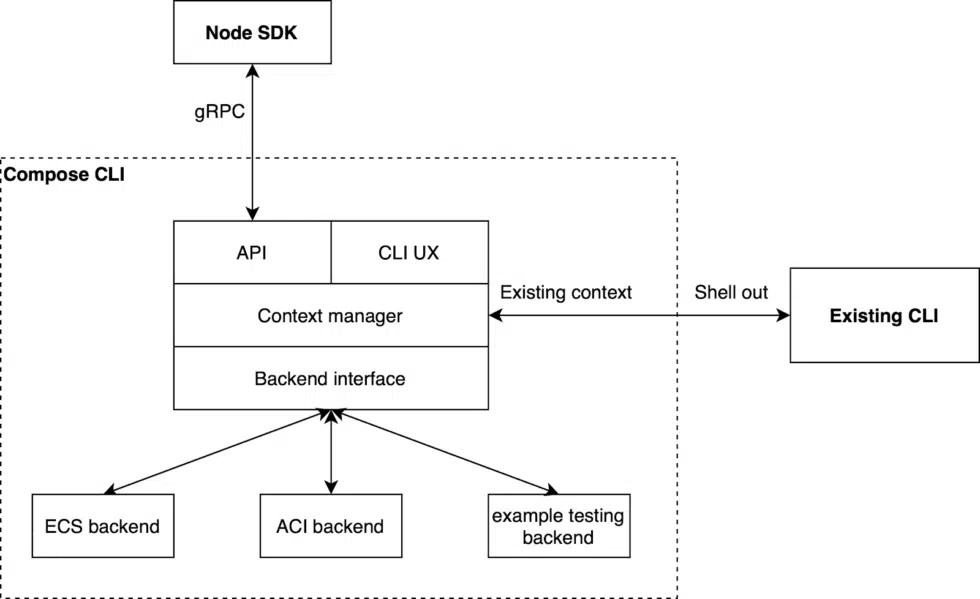
The company wanted to ensure that existing CLI commands were not affected when we implemented these connectors. They also desire an architecture that would allow adding more backends and SDKs in popular languages.

Docker inc have publicly sourced the Compose CLI and Node SDK sections of the diagram. This design is not final, and the Compose CLI will be merged with the existing CLI later.

Image Source: Docker Blog

The Compose CLI switches which backend is utilized for the command or API call based on the Docker Context that the user selects. This allows transparently transmitting commands to the existing CLI that use existing contexts.

The back-end interface enables creating a backend for any container runtime, allowing users to enjoy the same Docker CLI UX as before while also taking advantage of the new APIs and SDK. To give equivalent functionality to the CLI commands, the Compose CLI can serve a gRPC API.

They also utilize gRPC because it allows creating high-quality SDKs in popular languages such as Node.js, Python, and Golang. While the firm now only has a Node SDK that provides single container management on ACI, they also have plans to add Compose support, ECS support, and more language SDKs in the near future.

VS Code has already implemented its Docker experience on ACI using the Node SDK.Microsoft Windows Server now supports Docker containerization. Most cloud providers also provide services to assist developers in creating and running Docker-based applications.

Source: 9series

Boost Your Property Management Business In New York

Are you considering starting a property management company in New York City? Before jumping into the property management business, ensure to obtain the necessary skills and information. Property management may appear simple from the outside to people with little knowledge, but it is rather complicated.

Are you trying to figure out how to obtain more property management leads? The cornerstone to a profitable property management profession is lead creation. As a result, every proprietor or manager should learn how to generate property management leads.

To obtain property management clients, most companies depend on conventional marketing tactics. Yet, this is only beneficial if new leads can be generated from potential clients.

The worth of the property management sector is estimated around $88 billion by 2020 which was $90 billion in 2019.

A good lead generation strategy avoids wasting money and time by attracting the incorrect demographic. Instead, it enables businesses to concentrate on potential clients who are probably interested in the services they offer.

If you aim to start a new venture or are already in the property management business and want to expand further, this blog could provide sufficient insights.

1. Obtain the right skills to boost your business performance

The ability to stay organized, connect and sympathize with people, and respond to a variety of critical situations is just a few of the essential qualities of a competent property manager. You will be interacting with customers and prospects frequently, so excellent customer service skills are mandatory

You will also need to build positive working relationships with vendors, as you will require a network of contractors to take care of maintenance and other special requests. Ideally, you need to stay proactive in discovering opportunities for property owners to improve their properties while saving money.

2. Create a strong web presence

To acquire property management leads, you should have a strong online presence in addition to a website. Get your company included in key web directories for your sector.

To advertise your business and connect with potential customers, make the best use of social media sites like Twitter, Linked In, and Facebook. YouTube can help you promote your management services by uploading videos.

Real estate investors and Tenants will find you easier if you have a strong web presence. Furthermore, the NYC app development agency can help you provide efficient apps to serve your customers better.

3. Build a professional web page

Many potential customers will perceive an opinion of your brand based on their first website visit. It is critical to have a well-designed and professional website that will entice rental landowners and potential tenants.

Make sure that all of the information and photos are presented clearly and simply. Make sure your site is optimized for search engines to make it easy for property management customers to identify quickly.

4. Networking

Networking is an excellent approach to start expanding your client base. Connect with local real estate groups and business organizations. Establish connections with real estate agents who are in regular contact with landlords.

They may be in charge of properties and subcontract the property management job. Local contractors interact with property owners daily so that you may ask them for introductions.

Finally, promote your services through both online and offline mediums, and execute a paid search campaign to attract property owners looking for property management businesses in your area.

5. Efficient and Reliable employees

Depending on your demands, you may need to engage a team of staff to assist you with your accounting and the general upkeep of the property. Seeking lawyer assistance is a good option because they can assist you in comprehending any essential legal facts and defend your assets from potential threats. An accountant may assist in keeping track of income and ensuring that all fees, such as taxes, are paid.

You will also need personnel to keep the building clean and make sure everything is working properly. On average, the Property Management business in New York possess 2.9 employees. Hence, hiring efficient employees will make the process easier.

6. Real estate investor club

You can gain direct access to your target audience by engaging in real estate investor groups. You can let members understand your services by networking with them. Attend the meetup and socialize with the property owners and real estate investors.

Take it a step further once you’ve done that. Contact the meetup’s organizer and see if they’d be willing to let you speak at one of their future gatherings.

7. Leverage the marketing campaign strategies

You should consider implementing a paid marketing approach to improve your website and utilizing social media to increase your presence and outreach. This could range from placing ads in the local newspaper and funding a local event to handing out flyers, using Google Adwords, and paying for Facebook ads.

Final words

Make sure your adverts capture your potential customer’s pain points to produce more property management leads. Contact NYC app development agency to demonstrate how you can add value and make their life easier. Furthermore, adding a call to action encourages people to interact with your company.

Source: 9series

Effective Tips for Handling Stocks Through an Online Trading App

Stock market trading has become less time-consuming in recent years. Online trading allows you to trade without the help of a broker. A report states that over 55% of adults in the US do stock market trading. You can start selling stocks online in the same way that you can shop for groceries.

At the beginning of online trading, you do not need to be an expert as most of the platforms are user-friendly and do not require any training. Custom android app development in New York has made things even easier for investors and traders since you can do any stock market transaction using your smartphone.

The mobile trading software enables you to trade 24/7 from anywhere. Trade platforms give essential support and assistance by allowing secure real-time access to research reports, trading, stock price analysis, and market news, among other things.

Everything you need to know about trading app

Like all other apps supported by mobile, trading applications are designed to improve users’ effectiveness and efficiency whenever they execute a task in their personal or professional lives. Apps for stock trading, in particular, are designed to assist consumers in their hunt for reliable trading solutions.

The desired product should encourage consumers to stick to their unique investing strategy while fitting into their budget. A professional custom android app development New York can help in designing a responsive app with functional features.

Commissions and other trading fees can pile up quickly, costing frequent traders a lot of money. As a result, investing apps built with the end-user in mind should decrease or even eliminate unnecessary expenditures.

Several brokers provide investment opportunities in financial assets. After comparing brokers based on services, brokerage charges, and other factors, you may select the best that meets your needs and wants.

Do you know that the US accounts for over 55.9% of the total global stock market capitalization? Online trading platforms provide flexibility to trade or invest in the safest possible manner. Trading online is simple, straightforward, and quick.

The segments are financing and crowd-funding, wealth and asset management, capital markets, payments, and insurance services.

In the event of internet trading, the following safety precautions must be taken:

● Do not place trade orders from communal computers or cyber cafes.
● Always log out after making a trade to prevent your account from being hacked.
● Anti-virus software must be installed on personal computers to safeguard them from infections.
● If you log in to your account with trading credentials from various locations, do not use the “remember me” option.

Guidelines to efficiently trade through an online app:

1. Practice

Make imaginary trades and fine-tune your skills and system with a pretend account. Treat the procedure as if the money was real, and you’ll be able to find what works and what doesn’t work without taking any risks.

Switch to the actual thing once you’re sure in your approach and aren’t afraid of losing. In a notepad, keep an account of every deal you make and also the ones you’re considering. Long into the future, this trade publication will provide guidance.

2. Timing

One of the finest trading strategies is to avoid entering a trade during the first hour of trading since volatility is typically strong at this time of day. Many experts like to trade intraday between 12 p.m. and 1 p.m.

The NYSE opening and closing time is the most uncertain time, so avoid entering into the fray. Because of the bustle of activity, pricing mistakes and false trends are possible. Wait until the water has calmed before entering.

3. Watch the declining stocks

Keep an eye on your over-performing stocks the same way you keep an eye on your sputtering stocks. When you’re used to making money on a particular investment, it’s easy to make mistakes and expect it to keep paying off.

Keep an eye out for signals of a slowdown or decline, and get out as quickly as possible to keep your pluses from becoming minuses. If you lose money due to events beyond your power, chalk it to learning and move on. Don’t let that affect your next trade or you.

4. Do comprehensive research

Thoroughly investigate a set of stocks that you have found through professional intraday calls. Find out if there are any upcoming corporate events. Acquisitions, mergers, stock splits, bonus problems, and dividend payments are just a few examples. These may prove to be just as crucial as keeping up with technical levels.

Final words

Online trading platforms make the trading job easier because it allows for high-speed trading. Trading has changed thanks to these platforms. All you need is a trading account and internet access to buy and sell stocks. Not only that, but you may trade currency, commodities, and other financial instruments through a single trading platform.

Source: 9series

Latest Update on Docker Paid Subscription for Big Enterprise

Docker will limit the free edition of its Docker Desktop application to individuals or small enterprises. The company hunts for a sustainable revenue model and has introduced a new and expensive subscription.

Docker Overview

Docker Desktop is a graphical user interface (GUI) for controlling Docker components and operations, such as containers, local Kubernetes, images, volumes (containers related storage), development environments within containers, and so on.

Docker Desktop is one of several components that make up the Docker platform. Container contents are defined via Docker images, and Docker containers are usually runnable instances.

The Docker daemon is an application that runs in the background and handles Docker containers and images. The Docker client is a command-line tool that uses the Docker daemon’s API. Images are stored on Docker registries, and the Docker Hub is a popular public registry.

Update on Docker Subscription

Docker has introduced a new Subscription Service. The firm has renamed its free plan “Personal” and now requires enterprises with 250 or more employees or annual revenue of more than $10 million to use a premium subscription if they need Docker Desktop.

In addition, Docker has introduced a new Business subscription package for larger enterprises with a significant number of users. Under the new Docker Personal plan, which replaces the previous Docker Free, Docker Desktop remains free for educational institutions, personal use, non-commercial open-source initiatives, and small enterprises.

Docker Engine and the Moby project are unaffected by the new service agreement, which solely applies to Docker Desktop. The overall software developers globally grew to 23,9 million, and it’s anticipated to reach 28,7 million by 2024. This change would not affect the individual developers who try to explore things securely.

Docker Business, as previously announced, is a new subscription package aimed exclusively at businesses. Organizations that utilize Docker at scale will benefit from additional capabilities such as single sign-on (SSO), secure software supply chain management, container registry access controls, and more.
The new terms went into effect on August 31. However, Docker gave developers until January 31, 2022, to comply with the latest service regulation and purchase a premium membership if necessary. The Docker Pro, Docker Team, and Docker Business memberships are available to developers.

This is part of a larger adjustment to Docker’s license conditions, as CEO Scott Johnston plots a comeback for the once-famous container startup, which sold its enterprise division to Mirantis in 2019.

Under Johnston’s leadership, the company’s remaining assets have transitioned to helping developers create containerized apps, principally through Hub image repository, Docker Engine container runtime, and Desktop application, which is currently installed on 3.3 million machines.

New Docker Concepts

Personal, Professional, Team, and Business are the new price options, which replace the old Free, Team, Pro, and Large programs. The Personal plan is still free, whereas the Pro plan costs $5 per month for individuals and $7 per month for teams. The new Business plan costs $21 per month per user.

Large corporate users—an enterprise plan in all but name—would need to pay for additional capabilities like single sign-on, registry limitations, and secure software supply chain management, which will require a paid subscription.

Customers with a Docker Personal account will continue to have free access to Desktop, along with Docker CLI, Docker Engine, Docker Compose, Docker Hub, and Docker Official Images. The upstream open-source Docker, Docker Engine runtime, and Moby projects have all remained unchanged.

Docker Consultant anticipates that the amended license terms for Docker Desktop reflect the goal to scale the business sustainably and ensure that all Docker subscriptions continue to provide value.

In an interview, CEO Scott Johnston stated security issues with the software supply chain that the business wishes to fix. Additionally, the company seeks a more successful business model. In the developer sector, we expect to see growth.

According to the most recent data, there will be 45 million worldwide developers by 2030, up from 18 million today, necessitating the development of a sustainable and scalable business.

The Docker announcement, as expected, triggered a debate among developers. While many people seemed to understand the reasoning behind Docker’s increased subscriptions, others expressed their displeasure. Criticism evolved along two distinct paths.

On the one hand, several people thought Docker’s action created a potentially dangerous precedent, raising the likelihood of future subscription prices and lock-in. Others argue that this view ignores the greater costs that a company would suffer if it were to rely on poorly maintained open-source software.

The majority of worries revolved around managing procurement activities within corporate entities, making it more difficult for developers to continue utilizing Docker and introduce various complexity.

As a result, many developers have begun investigating alternatives, such as Canonical-supported micro k8s, minikube, and others. Approaching a reliable docker consultant will help you make the right decision on your new development projects.

Source: 9series

Easy Methods To Share Files From Host To Docker

Docker is a prominent containerization solution that gives software applications a filesystem with whatever they need to run. It is one of the fastest growing technologies, statistics demonstrate study growth rate of over $1,382.1 million by 2026, with growth rate at a CAGR of 17.2%. Because the run-time environment of Docker containers is consistent, the software will act the same irrespective of where it is deployed.

Docker container development is not as straightforward as traditional application development. It can go smoothly once you’ve decided on a procedure. It is, however, not complicated as people expect. It’s just a matter of understanding how simple Docker containers are to use.

Professional Docker consulting services can help you share data between a host and docker containers as a simple operation. A report states that over 50% of the companies use container technologies.

A developer may desire to write code outside the container. Perhaps more than one person is working on the project, but only one team member has access to the operating container.

The people would share their code in this circumstance, and the lead would then have to get the unique code into the container. Though there is a chance to cut and paste, it could be easier to use a single command to copy the new file.

Docker containers are temporary, lasting only as long as the command issued in the container completes. Any data created within the container is only accessible from the inside container while it is running by default.

However, there are situations when apps need to share or keep data after a container is removed. Databases, user-generated material for a website, and log files are a few samples of data that are difficult or impossible to incorporate in a Docker image but required by applications. Docker Volumes give you consistent access to your data.

Docker Volumes can be generated and attached as part of the same command that produces a container, or they can be produced separately and attached afterwards.

Prerequisite

Docker consulting services recommend you to have a functioning Docker instance and a user that belongs to the docker group to make this work.

Method 1 – Using Docker cp command

The Docker cp command copies directories and files from the host machine to the container and vice versa. You can use the command below to copy a single file from the host to the container.

docker cp <source path><container>:<destination path>
docker cp <container>:<source path><destination path>

The command docker cp replicates the contents of the source path to the destination path. Files can be copied from a local host machine to a Docker container and vice versa.

Note that the docker cp command expects that docker container paths are equivalent to the docker container’s root directory “/.” It means that the following commands are the same whether you use slash at the start of the route or not, and they will work.

Let’s have a detailed look to transfer files from the host to the Docker container

STEP 1 – Bind Mounting a Volume

Create a directory called nginx logs in the current user’s home directory and bind mount it to /var/log/nginx in the container with the following command:

docker run –name=nginx -d -v ~/nginxlogs:/var/log/nginx -p 5000:80 nginx

Copy
Let’s have a look at this command in more detail:

  • The container is given the name nginx so that we may refer to it more readily.
  • -d separates the process from the rest of the system and executes it in the background. Otherwise, we’d just be staring at an empty Nginx prompt, unable to utilize this terminal until Nginx was destroyed.
  • -v ~/nginxlogs:/var/log/nginx creates a bind mount volume that connects the Nginx container’s /var/log/nginx directory to the host machine’s /nginxlogs directory. Docker divides the host path from the container path using a, with the host path always coming first.
  • A port forward is set up with -p 5000:80. By default, the Nginx container listens on port 80. This flag links the container’s port 80 to the host system’s port 5000.
  • The container should be constructed from the Nginx source code, according to nginx.

Step 2: Obtaining Data from the Host

Our host computer’s port 5000 maps directly to that copy of Nginx’s port 80, and we now have a copy of Nginx operating within a Docker container on our system.

Use your server’s IP address or hostname and the port number to load the address in a web browser: http://your server ip:5000.  You should check out:

More interestingly, we can see the access.log written by the container’s nginx in the /nginxlogs directory on the host, which shows our request:

cat /nginxlogs/access.log

If you make any changes to the folder, you can see them in real-time from within the Docker container.

Source: 9series

A Quick Comparison of Docker vs. VM: Which DevOps Tool is Best?

Every application has its own set of dependencies, which comprise both software and hardware. A virtual machine (VM) is a software or computing environment that allows developers to access an OS through a physical machine.

When compared to conventional technologies, Docker containers introduce a slew of new tags to the chart. In terms of technology, it’s particularly intriguing in circumstances where it aids cloud portability by allowing users to execute the same programs across many virtual environments.

Docker is the most widely used container technology, according to Statista research. Docker is an open platform for developers, and it’s a tool for isolating application dependencies by putting them into containers. Containers are more scalable and easier to utilize and deploy than earlier methods.

For many of the benefits of cloud architecture, the VM has been the go-to standard. But what if there was a lighter, more cost-effective, more scalable equivalent to a virtual machine? Docker is a container-based platform mainly used for developing distributed applications.

Key Difference between Virtual machines Vs. Docker containers

  • The OS support, portability, security, and performance are notable contrasts. Virtual machines and Docker containers have extremely diverse operating system support. When there are ‘n’ virtual machines, each virtual machine has its guest operating system that runs on top of the host operating system, making virtual machines quite hefty. Docker containers, on the other hand, share the OS, which is why they are lightweight.
  • The containers share the host operating system, making them relatively light and allowing them to boot up in a matter of seconds. As a result, when compared to virtual machines, the overhead of managing the container system is quite minimal. Docker containers are best used when you need to execute numerous programs on a single os kernel. On the other hand, virtual machines are essential if servers or applications run on several operating system flavors.
  • A Reliable docker deployment consultation helps you find the most significant distinction between a virtual machine and a Docker container. A virtual machine is a computer that is emulated by software, and a single specific computer can run several virtual machines, each with its operating system. On the other hand, Docker is a virtual machine-based container platform, and a container has no existence outside of the host’s operating system.

Virtual Machines and Docker Containers – Compliments each other

Docker Containers are reshaping the DevOps (developer operations) environment as a critical element in the DevOps toolbox. Docker Containers have a wide range of applications in the DevOps world. Using Docker Containers to run programs and then deploying them wherever (Cloud, on-premise, or any Linux flavor) is now a reality.

Virtual Machines enable considerable flexibility in heterogeneous environments, whereas Docker containers are focused on programs and their dependencies.

The only point of view that suggests which of the two should be picked is application design. Containers are ideal for applications requiring scalability and high availability; otherwise, virtual machines can be used.

However, Docker containers have certainly challenged the virtualization business. Containers in VM are easily said to be twice as resilient as one without the other. A hybrid strategy that uses both Docker and VM can be used on occasion.

Here are a few of them, along with explanations on how they work together as a Hybrid:

  • Virtual Machines and Docker Containers are insufficient to run an application in production on their own. As a result, one should think about how Docker Containers would run in an enterprise data center.
  • Containers provide application probability and enable consistent provisioning of the application across the infrastructure. Other operational requirements, such as performance, security, capacity management, and management tool integrations, remain difficult for Docker Containers, leaving everyone perplexed.
  • Both Virtual Machines and Docker Containers are capable of providing security isolation.
  • Docker Containers, despite being two independent technologies, may run inside Virtual Machines and give benefits such as proven isolation, mobility, security properties, software-defined storage, dynamic virtual networking, and a large ecosystem.Docker deployment consultation service providers can provide statistical insights on its benefits and deployment.

On a physical host with a specific configuration and virtual machines with the same configuration, running the same amount of Docker Containers with the similar performance on both.

Virtual Machines or Docker Containers – Which is the most effective?

The answer to this is not certain. However, experts suggest that containers are gaining ground on virtual machines based on their configurations and benefits. Gartner, a well-known global research firm, predicts that by 2023, more than 50%of all businesses will be using Docker containers. 

However, revenue for a serverless container like Docker will increase from $465.8 million in 2020 to $944 million in 2024, from a low base of $465.8 million in 2020.

9series Inc – Clutch Year In Review 2021

9series Leaves A Positive Mark On Their Clients

When we ask clients for their opinions on our work we do our best to make them happy and hope we made a good impression. We recently took a look at our year-in-review dashboard on Clutch to see how well our profile did in the past twelve months.

While we liked all the metrics and data that the dashboard provided, this highlighted from one of our reviews really stood out to us.

Clutch Year In Review

We are so happy that our efforts were not only recognized but shared on a different platform. Reviews only work when people are free to speak their minds about the relevant topic. To know that we made such a good impression on a client is all we could ask for.

While Clutch is known as a B2B ratings and reviews platform, it can be a source of motivation for us who decide to open ourselves to feedback and possible criticism. Our team works with extra effort knowing that any slip-up can reflect back on us in a review. In addition, all the positive feedback we get motivates our team to do even better for the next project that comes around.

Our team successfully ended 2021 on a high note and we genuinely want to continue this trend moving forward into the new year. We look forward to meeting all of our future clients and making them happy with their projects and the results we’ll deliver.

Learn more about all the services we offer on our website. You can also contact our team directly and get the answers you need at the soonest possible time.

Source: 9series

Design a site like this with WordPress.com
Get started